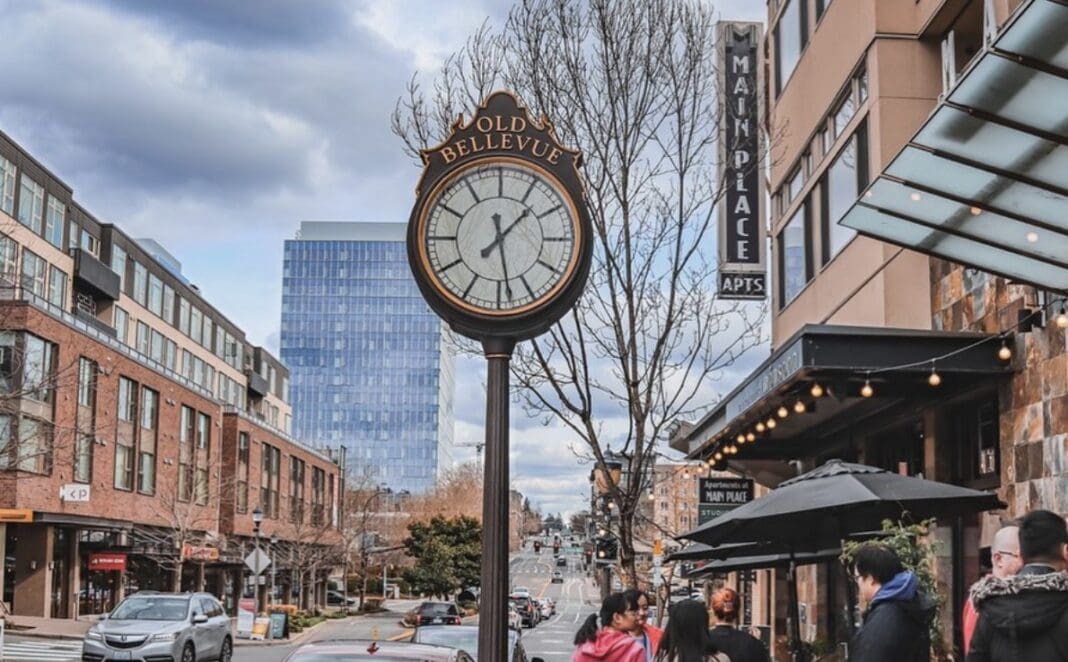

The Bellevue City Council recently approved an amendment to retain existing stepback requirements along Main Street in Old Bellevue. Stepbacks require upper floors of buildings to be set back from the street, helping maintain a pedestrian-friendly streetscape and the character of the neighborhood.
The amendment passed with Dave Hamilton and Jared Nieuwenhuis voting against it. Councilmembers noted that the stepback standards are critical for preserving the walkable feel of Old Bellevue while still allowing new development to occur.
Background: Temporary Development Controls
This decision builds on a temporary ordinance approved in February that placed development restrictions on a section of Main Street in Old Bellevue. The ordinance, passed on Feb. 10 in a 4-3 vote, established an Interim Official Control (IOC) for properties between 100th Avenue NE and Bellevue Way.

Under the IOC, any new development must be compatible with adjacent properties and reflect the neighborhood’s established design characteristics. Property owners seeking to demolish facades more than 50 years old must demonstrate that the building has no historic or cultural value.
City officials have noted that none of the affected buildings are designated as state or national historic landmarks. The ordinance does not apply to projects already approved or vested under current zoning regulations.
Development Proposals That Prompted Action
The council’s action followed development activity in Old Bellevue, including a 176-unit apartment project by Vander Hoek Corp. at Main Street and 103rd Avenue NE. Plans for the eight-story building include 176 residential units and more than 10,000 square feet of ground-floor retail. Because this project is grandfathered under existing zoning, it is not affected by the IOC or the stepback amendment.

Instead, the temporary and updated regulations apply to other properties along Main Street that have not yet begun the permitting process.
Purpose of the Interim Official Control
The IOC was designed to provide time to evaluate long-term standards for Main Street development without delaying action through extended hearings. It remains effective while the city considers permanent development standards, including potential updates to design and building guidelines.
The ordinance does not require developers to retain existing businesses or tenants, as the city cannot mandate specific commercial occupants under current land-use regulations.