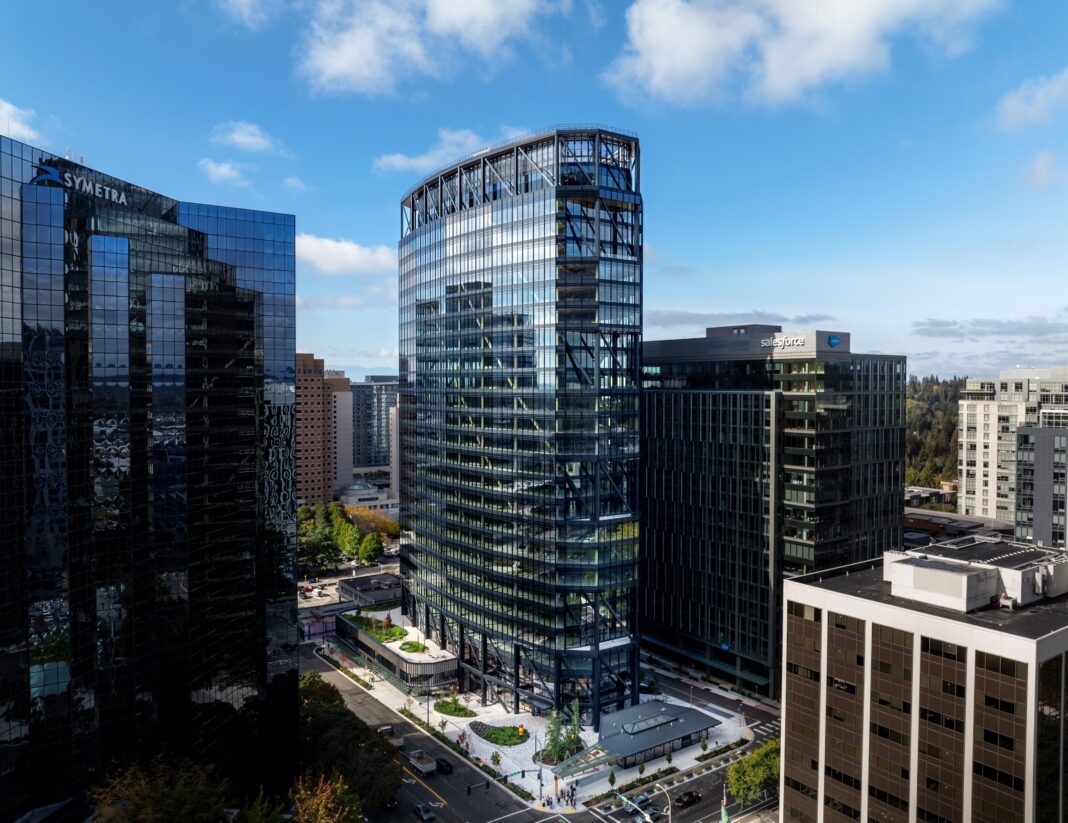

A typical downtown Bellevue condo or apartment would pay about $10 more a month for water, sewer and stormwater service next year, and about $19 more by 2028, under rates now before the Bellevue City Council. Restaurants and other businesses that use a lot of water would see some of the steepest increases.
City staff presented the proposal to the council on Oct. 13 as part of the preliminary 2027–2028 budget. Combined utility rates would rise 8.5% in 2027 and 8.6% in 2028. Nothing has been approved yet. The council holds its final public hearing on the budget Oct. 27 and is scheduled to adopt it Nov. 17.
What Is Being Proposed
Bellevue Utilities bills customers for three services, and each would go up by a different amount in both 2027 and 2028:

- Sewer: 10.1%
- Water: 6.7%
- Storm and surface water (the drainage system that carries rain off roofs and streets): 6.0%
The 8.5% figure is the average across all three services and all customers. Individual bills will rise more or less than that depending on the type of property and how much water it uses.
Why Rates Are Going Up
Bellevue does not treat its own sewage or own its water source. It pays King County to treat wastewater and buys water from Cascade Water Alliance, a regional supplier. Both are raising their prices. The city projects King County’s treatment charges will rise 12.75% a year in 2027 and 2028, and Cascade’s water costs will rise 9.5% a year.
Those outside costs account for 51% of the proposed increase, according to city staff. Another 34% goes to repairing and replacing aging pipes and other infrastructure, and 15% covers day-to-day operations.

If You Own a Condo or Rent an Apartment
The city’s typical multifamily bill is $128.40 per unit per month in 2026. Under the proposal, it would rise to $138.55 in 2027 and $147.22 in 2028.
That works out to increases of 7.9% and then 6.3%, smaller than the citywide figure. The reason is a change in how sewer costs are split. Starting in 2027 and phasing in through 2031, the city plans to shift part of the sewer cost away from multifamily buildings and onto single-family homes.
The totals add up at the building level. A 200-unit tower at the typical rate would go from paying about $25,680 a month in 2026 to $27,710 in 2027 and $29,444 in 2028, or about $45,170 more a year by 2028.
In many condo towers, the building shares a meter and the homeowners association pays the utility bill out of monthly dues. Apartment owners may pass the cost to tenants through rent or a separate utility charge, depending on the lease.
If You Own a House
Single-family homes would see larger increases, partly because of the sewer cost shift. The typical bill would go from $229.52 a month in 2026 to $251.03 in 2027 and $274.58 in 2028, an increase of about 9.4% each year and about $45 a month by 2028.
If You Run a Restaurant or Business
The city did not publish a typical business bill, because charges depend on meter size, water use and lot size. The 2026 rate sheet shows how a business bill is calculated. Bills are sent every two months:
- Water: a base charge based on meter size, from $67.22 for a 3/4-inch meter to $309.27 for a 2-inch meter, plus $6.66 for every 748 gallons used, or $9.09 from July through October
- Sewer: $15.04 for every 748 gallons of water used, with a minimum charge of $234.03
- Stormwater: based on how much of the property is covered by roofs and pavement, at $26.25 per 2,000 square feet for properties more than 70% covered
Because the sewer charge is based on how much water a business uses, sewer is typically the largest piece of the bill for restaurants, bars, salons, gyms and hotels. It is also the service rising the most.
At 2026 rates, a business pays $2,170 in water and sewer charges for every 74,800 gallons it uses in a non-summer billing period. If those charges went up by the same percentages as water and sewer overall, the same amount of water would cost about $2,367 in 2027, roughly $197 more. City staff said business sewer bills will rise slightly more than the sewer average because of the sewer cost shift.
The city also plans to stop charging one-time utility connection fees on customer bills and collect them during the building permit process instead. No start date has been set.
More Households Could Qualify for Help
The budget would expand the city’s Utility Bill Assistance Program in 2027 to every household earning at or below 80% of area median income. Those households would get 35% off their basic utility costs, up to $900 a year. Low-income seniors and residents with disabilities already in the program would keep their 70% discount.
With the 35% discount, the city projects a typical 2027 multifamily bill of $95.51 per unit per month. The budget sets aside about $5.2 million for the expansion through 2032.
Who Decides
City staff developed the rates as part of City Manager Diane Carlson’s proposed budget. Bellevue’s Environmental Services Commission, a seven-member citizen advisory board, held a public hearing Sept. 3 and voted Sept. 17 to recommend them. The City Council makes the final decision.
The utility rates are one piece of a larger budget that also includes a $1.3 billion capital plan and a possible new car tab fee and sales tax for transportation. Councilmembers voted 6-1 in October to take on the powers of a Transportation Benefit District, a step that does not by itself impose any new tax.
What Comes Next
The council’s final public hearing on the budget is Oct. 27. Councilmembers are scheduled to deliberate Nov. 3, give direction on Nov. 10 and adopt the budget, including the utility rates, on Nov. 17.
The increases are not expected to stop in 2028. The city’s long-range forecast projects combined rate increases of 9.3% in 2029 and 2030 and 8.1% in 2031 and 2032. Those years are not part of the current proposal.