
When Seattle was named a host city for the FIFA World Cup 2026™, Bellevue positioned itself to capture a share of the economic activity flowing into the region. City officials and local organizations spent months preparing programming meant to draw match-day crowds into Bellevue, and new figures released this week show what that preparation actually delivered.
The Buildup: Bellevue’s World Cup Game Plan
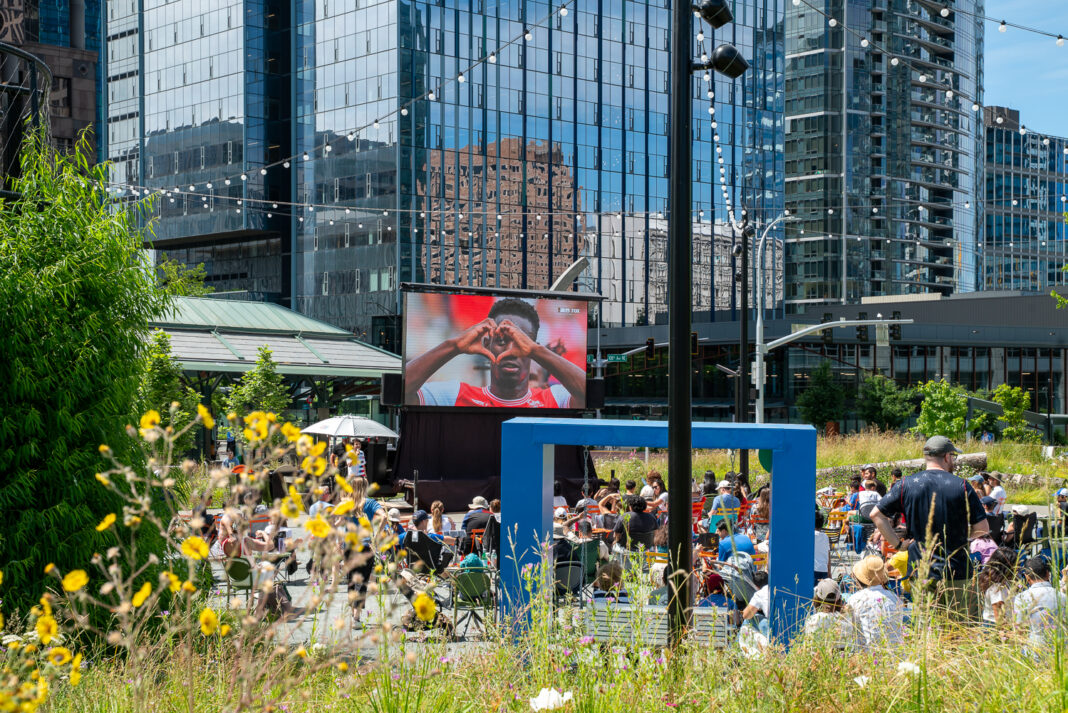
In the months leading up to the tournament, the City of Bellevue worked with local groups to build out public events tied to Seattle’s World Cup matches. Watch parties and community celebrations were planned near Bellevue’s light rail stations on match days, giving residents and visitors a way to take part in the tournament without needing to travel into Seattle.
The city contracted four organizations to lead this community programming for residents, workers, and visitors: the Bellevue Downtown Association, Visit Bellevue Washington, the BelRed Arts District, and the Spring District Authority. The city’s Community Programming Fund provided additional financial support for related events.

Plans called for Bellevue’s light rail stations to feature live music, pop-up art installations, food trucks, and multilingual signage, all aimed at extending match-day energy into the surrounding neighborhoods before and after games in Seattle.
The push carried financial stakes for the city. Bellevue is Washington’s second-largest hotel market, and organizers projected roughly 15,000 overnight visitors from around the world would pass through the city during the tournament, drawn in part by its lodging options, dining, shopping, and direct light rail access to Seattle.
The Results: What the Numbers Show
Visit Bellevue Washington, has now released preliminary tourism impact figures for the FIFA World Cup 2026™ period, and the early data indicate the city’s hotel sector benefited from its position as a connected regional destination.

Rather than a jump in occupancy, Bellevue’s strongest gains showed up in room rates, overall hotel revenue, and its slice of the broader regional lodging market.
During the periods immediately before and after Seattle’s matches, hotel occupancy in Bellevue rose about 1%, while average daily room rates climbed approximately 14.2% and total hotel revenue increased close to 16%. The city’s share of King County’s overall lodging activity also grew to an estimated 13%, suggesting Bellevue pulled in a larger portion of regional visitor demand than it typically would during the same stretch of summer.
Visit Bellevue’s tourism impact model puts total World Cup-related hotel room nights at approximately 14,500, a total that accounts for fans, traveling teams, staff, media, sponsors, corporate groups, and event operators tied to the tournament. Of that total, the model estimates about 17,600 long-haul visitors traveled to Bellevue specifically because of the World Cup. Taken together, this visitor and group activity is estimated to have generated $12.5 million in combined overnight visitor economic impact for the city.
Visit Bellevue notes these figures are modeled estimates built from current lodging and visitor data, not final totals. A fuller accounting of non-lodging spending, covering restaurants, retailers, attractions, and other downtown businesses, is expected in mid-August and will round out the picture of the tournament’s impact on Bellevue’s broader economy.
For now, the available data points to a favorable outcome for the city’s hospitality sector: stronger hotel pricing and revenue, a larger share of regional lodging demand, and a visibility boost from association with one of the world’s most-watched sporting events.